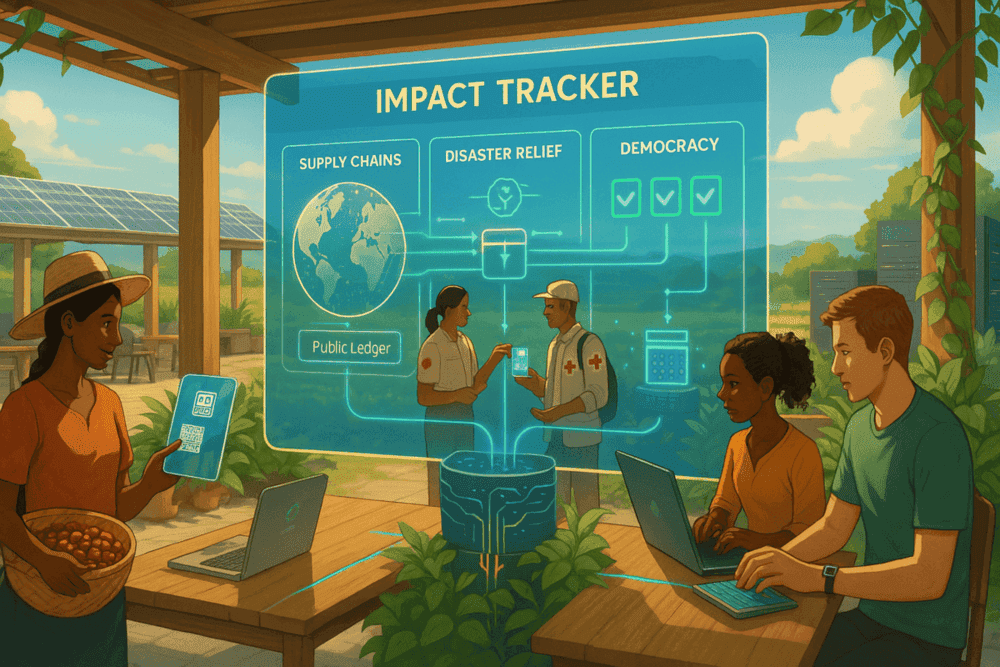
|
When most people hear blockchain, they think of Bitcoin, NFTs, or volatile markets. But beyond the buzzwords and billion-dollar headlines lies a quieter revolution—one driven by social good.
Blockchain’s core features—transparency, immutability, and decentralization—make it a powerful tool for solving some of the world’s toughest challenges. From improving how aid is distributed to restoring trust in broken institutions, blockchain is proving that it can be more than a tech trend. It can be a force for real impact.
Radical Transparency in Action
One of blockchain’s biggest contributions is its ability to create open, verifiable records. In sectors plagued by corruption, bureaucracy, or inefficiency, this is a game changer.
Example:
In countries receiving international aid, blockchain can track where every dollar goes—from the donor’s wallet to the recipient’s hands. This reduces fraud and ensures that resources reach the people who need them most.
Use Cases:
NGOs tracking food and medicine delivery
Governments issuing land titles or IDs that can’t be altered
Election results being stored on tamper-proof public ledgers
Trust becomes less about who’s in charge and more about the integrity of the system.
Financial Inclusion Through Decentralization
Globally, over 1.4 billion people remain unbanked. Traditional financial institutions can be inaccessible, biased, or unreliable. Blockchain offers a workaround.
With only a smartphone and internet access, anyone can create a crypto wallet, access DeFi services, and participate in a global economy without needing a bank.
Real-world impact:
Microloans on blockchain platforms help small businesses in remote areas
Refugees use blockchain-based identity systems to prove who they are and access funds
Remittances are sent across borders with lower fees and faster delivery
It’s not just about money—it’s about autonomy and access.
Tracking Impact, Not Just Transactions
For charities and socially-driven organizations, proving impact is just as important as collecting donations.
Blockchain enables smart contracts that automatically trigger actions when certain conditions are met—like releasing funds only after a milestone is verified. Donors can see exactly how their contributions are used, building confidence and encouraging long-term support.
Imagine a world where:
You donate to a clean water project and receive updates when the well is built
Your contribution to a school fund unlocks supplies once student attendance reaches a target
You support a reforestation effort and see your specific tree’s coordinates on a live map
Transparency drives engagement—and accountability.
Ethical Tech at Scale
Blockchain isn’t perfect. It faces challenges like energy consumption, scalability, and regulatory grey zones. But new developments—like energy-efficient consensus models (e.g., proof of stake) and green blockchains—are addressing these concerns.
For blockchain to fulfill its potential for good, the tech community must prioritize:
Ethical deployment over hype
Human-centered design over speculation
Collaboration with public institutions and local communities
It’s not just about what blockchain can do—it’s about what we choose to do with it.
Final Thoughts
Blockchain has already disrupted finance. But its true legacy may be written in the margins—where it brings transparency to opaque systems, trust to broken ones, and opportunity to those left out of traditional structures.
As we look to the future, the most powerful use of blockchain might not be building wealth. It might be building a better world.

Jasper Lin
Blockchain
7k
623
84
Similar News




Podcasts
AI Revolution
AI Barriers
TechTalk AI
AI Conversations
Resources