|
What will life look like in 2050?
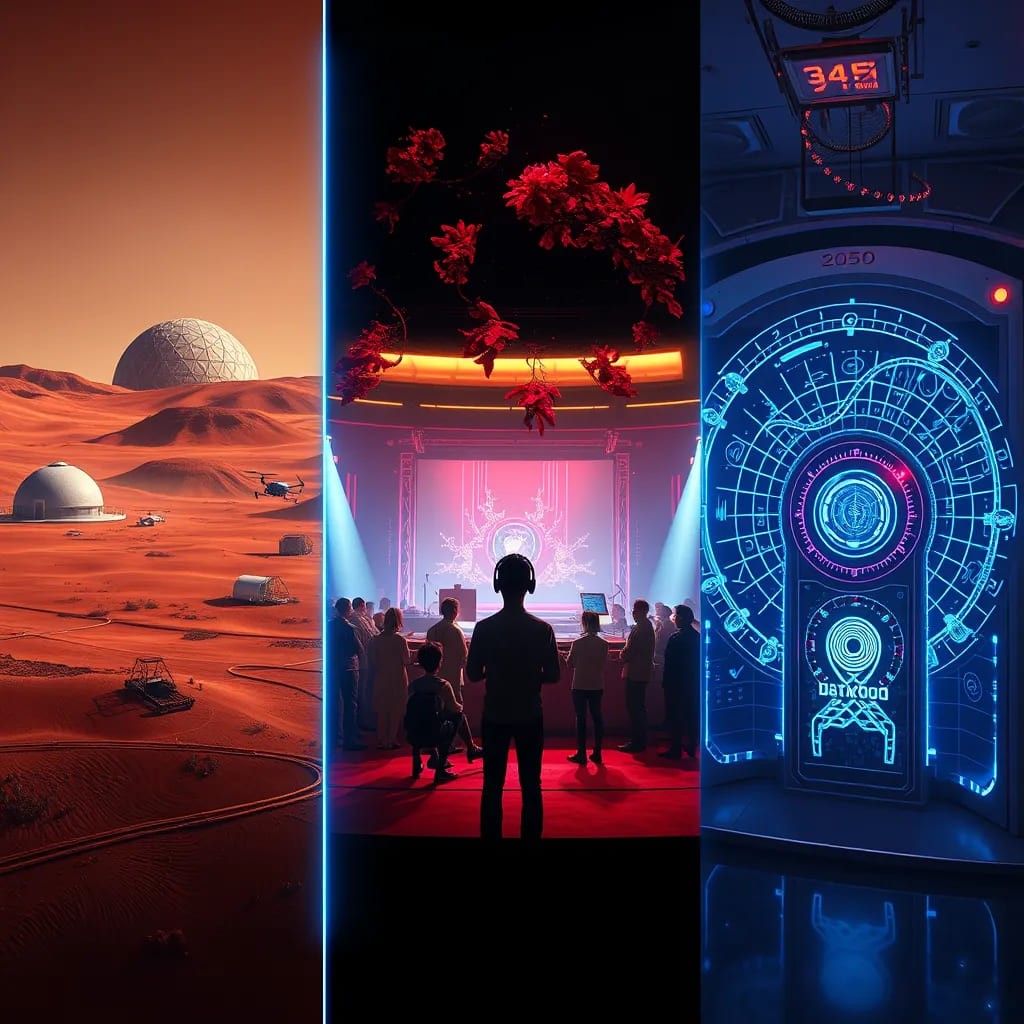
Picture this: humans commuting between Earth and Mars, attending work meetings in hyper-realistic metaverses, and contemplating what it means to live forever—digitally. While some of these ideas sound like science fiction, the trajectory of today’s innovations suggests they might be closer than we think.
The future isn't arriving all at once—it’s unfolding in layers. And if we follow the threads of space exploration, virtual reality, and neural technology, we start to see the outline of a radically different world.
Humanity's Martian Chapter
Mars has long symbolized human curiosity and ambition. But by 2050, it may also represent our next address.
Private companies and space agencies are laying the groundwork for permanent Martian settlements. SpaceX, NASA, and international partners are developing the infrastructure—from reusable rockets to self-sustaining habitats—that could make life on the Red Planet viable.
This isn't just about planting flags. It’s about creating a backup for humanity, tapping new resources, and redefining our relationship with the cosmos.
Imagine a world where:
Scientists live in rotating shifts on Mars
Tourists orbit the Red Planet before returning to Earth
Terraforming isn't just a theory—it’s a decades-long project
Metaverses as the New Reality Layer
Back on Earth, another frontier is expanding: the metaverse.
By 2050, virtual worlds won’t just be for gaming or entertainment. They’ll be layered into education, healthcare, remote work, dating, and even government services. These metaverses will be interoperable, hyper-personalized, and powered by AI and brain-computer interfaces.
You won’t just enter a Zoom call—you’ll walk into a virtual conference center as your photorealistic avatar. Education may happen inside immersive simulations, and therapy could be delivered through AI companions in calm, customizable spaces.
The lines between “real” and “virtual” will blur—but the goal isn’t escape. It’s enhancement.
Uploading Consciousness: Science or Soulcraft?
Perhaps the most controversial vision of 2050 is mind uploading—the theoretical process of transferring human consciousness into a digital form.
While today’s neural interfaces can help paraplegics move robotic limbs or allow people to type using thought alone, future technologies may eventually map the human brain with enough precision to simulate identity, memory, and awareness.
This opens a Pandora's box of philosophical questions:
If your mind lives on digitally, is it still you?
Can digital consciousness experience emotion?
Should these minds have rights?
Whether through full uploads or hybrid extensions (like memory augmentation), the concept challenges our definitions of life, death, and self.
The Convergence of Frontiers
These three domains—Mars, the metaverse, and mind uploads—aren’t isolated. They’re converging.
A Martian colony could be guided by AI designed and tested in virtual worlds. Colonists may stay connected to Earth via shared virtual environments. Digital minds might help run autonomous systems on distant planets or even serve as explorers in environments too harsh for biology.
In this vision, Earth becomes just one node in a larger, interconnected network of minds, worlds, and realities.Monitor Performance
Utilize the built-in Framer analytics to track performance metrics and adjust content strategy based on data insights. By combining these best practices with technical best techniques, you can create a blog that not only engages and informs but also performs well in search rankings and user engagement. Happy blogging!
The Ethical Compass of Tomorrow
As we shape 2050, the biggest question isn’t can we—it’s should we.
Technologies this powerful demand new frameworks of ethics, governance, and empathy. Who gets access to mind uploading? Will metaverses deepen inequality or democratize opportunity? And who gets to decide humanity’s role on Mars?
Designers, scientists, lawmakers, and citizens will all play a role in steering the course—not just with code or policy, but with values.
Final Thoughts
The road to 2050 is already under construction. And while it's paved with innovation, it’s also rich with mystery.
By imagining our future boldly—but building it mindfully—we don’t just predict what’s next. We prepare to create a world where exploration, identity, and humanity itself are continuously redefined.
Because whether we’re standing on Martian soil, navigating a virtual society, or contemplating digital immortality—our greatest tool remains the imagination.

Camila Rhodes
Futurism
23k
875
562


Podcasts
AI Revolution
AI Barriers
TechTalk AI
AI Conversations
Resources